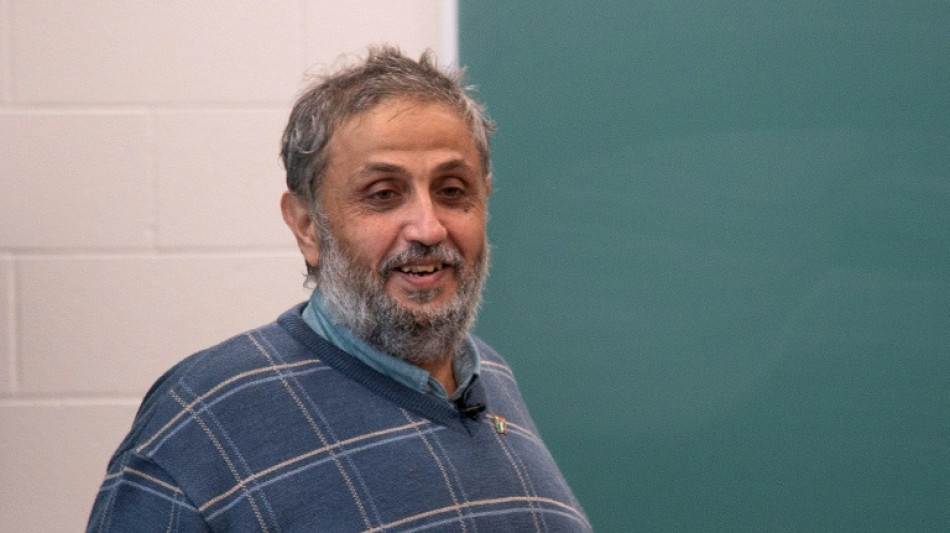
From Canada, professor tries to keep Gaza university 'alive' / Photo: Jorge Uzon - AFP

 Myanmar junta seeks to prosecute hundreds for election 'disruption'

 Knicks beat Spurs in NBA Cup final to end 52-year trophy drought

 Grief and fear as Sydney's Jewish community mourns 'Bondi rabbi'

 Brazil Senate to debate bill to slash Bolsonaro jail term

 Eurovision facing fractious 2026 as unity unravels

 Asian markets drift as US jobs data fails to boost rate cut hopes

 Ukraine's lost generation caught in 'eternal lockdown'

 Australia's Steve Smith ruled out of third Ashes Test

 Undefeated boxing great Crawford announces retirement

 UK experiences sunniest year on record

 FIFA announces $60 World Cup tickets after pricing backlash

 Nested Knowledge and Pharmacy Podcast Network Announce Strategic Collaboration to Advance Evidence-Based Podcasting in Healthcare

 Costa Rican president survives second Congress immunity vote

 Australia holds first funerals for Bondi Beach attack victims

 Rob Reiner killing: son to be charged with double murder

 Netflix boss promises Warner Bros films would still be seen in cinemas

 Stocks mostly retreat on US jobs, oil drops on Ukraine hopes

 Trump imposes full travel bans on seven more countries, Palestinians

 Shiffrin extends slalom domination with Courchevel win

 Tepid 2026 outlook dents Pfizer shares

 FIFA announces $60 World Cup tickets for 'loyal fans'

 Shiffrin dominates first run in Courchevel slalom

 Arctic sees unprecedented heat as climate impacts cascade

 Afrikaners mark pilgrimage day, resonating with their US backers

 Hamraoui loses case against PSG over lack of support after attack

University professor Ahmed Abu Shaban often gets up at 3:00 am in Toronto to remotely teach his students in Gaza -- motivated by loyalty to his trapped pupils, and a deep sense of guilt.
Shaban, an academic who fled Gaza days after October 7, 2023, said he has an obligation to students in the Palestinian Territory desperate to study in defiance of unimaginable challenges.
He also said he has a responsibility to help preserve higher education in Gaza, while the world is focused on the humanitarian emergency.
But the 50-year-old conceded that guilt also weighs on him.
"Guilty for leaving Gaza," he told AFP. "Like we just abandoned our country, our people, our institution."
Shaban is still the dean of the Faculty of Agriculture and Veterinary Medicine at Al-Azhar University, which was destroyed -- along with most university buildings -- by Israeli air strikes.
Shaban crossed to Egypt shortly after the war began, anticipating Israel's response to the Hamas attack would be "massive," he said.
Canadian contacts arranged a posting at Toronto's York University, where he is a visiting professor in the Faculty of Environmental and Urban Change.
In a campus office with empty book shelves and mostly bare walls, Shaban explained that he felt compelled to help make Al-Azhar operational in some form.
He wanted "to give the very clear message for the whole world: Yes, they just destroyed our infrastructure. Yes, they destroyed our buildings... but we are still alive and we will just continue," he said.
"This is actually a responsibility for our students, for our nation, and for our independent state in the future."
- Hunger to study -
Shaban, who is on Al-Azhar's board, said its pre-war enrolment was 14,000 students.
When registration opened for online courses earlier this year he expected 1,000 students to join.
"We got 10,000," he said.
"It was really, for me, shocking because, just imagine: you live in a tent, you have no electricity, you have no internet. You have nothing at all.
"But you still have the hope to go to sign up for online courses and to walk for five (kilometres) to get internet connection and even to communicate, to sit and study. And sometimes you risk your life even while you are searching for internet."
Shaban conceded his personal schedule is "stressful," as he tries to work in two time zones.
One day last month, he was up at 3:00 am to join a workshop on Gaza's food system, before an Al-Azhar board meeting at 6:00 am. He then headed to his Toronto office to prepare a guest lecture on the Gaza war.
On evenings and weekends he records and uploads lectures for his Palestinian students.
Shaban said the study program is flexible, given the challenges of internet access. Students watch lectures and complete assigments when they can get online.
- Star student killed -
He said students in Gaza can be "angry" and "pushy": they want to know, for example, when they will able to do lab work, even though all the labs have been destroyed.
Shaban said he understands their frustrations.
"Sometimes you feel the students are looking at us like we can do things that actually are not doable," he said. "I have to be responsive in a gentle way."
As agitated student messages pour in, Shaban said he reminds himself that he is living comfortably in a city with electricity and grocery stores stocked with food.
"(I) try just to provide them with whatever support that I can. There are many things that I cannot do," he said.
Students who have died are always front of mind.
He recalled five engineering students killed as they gathered by an internet source to work on an assignment.
Shaban said he will never forget his "star student" Bilal al Aish, who, days before the war started, was trying to decide whether to pursue a scholarship in Germany or the American Fulbright.
"I saw the hope in his eyes, not only for his own future, but also the future of our institutions."
Shaban said Aish was killed by an Israeli strike early in the war.
"I got the feeling they are killing the future," the professor said. "That was really painful for me."
P.Hernandez--AT