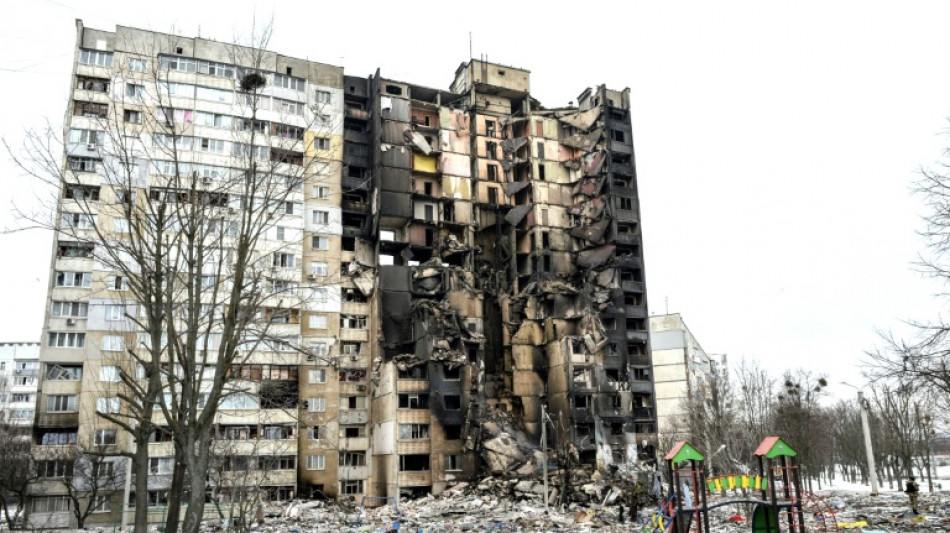
Urban warfare 'nightmare' looms if Russia enters Ukraine cities

 Billionaire Trump nominee confirmed to lead NASA amid Moon race

 Melania Trump steps into spotlight in Amazon film trailer

 Safonov hero as PSG beat Flamengo in Intercontinental Cup

 Oscars to stream exclusively on YouTube from 2029: Academy

 Brazil threatens to walk if EU delays Mercosur deal

 Rob Reiner's son appears in court over parents' murder

 Three Russia-themed anti-war films shortlisted for Oscars

 Palace boss Glasner says contract talks on hold due to hectic schedule

 Venezuela says oil exports continue normally despite Trump 'blockade'

 India v South Africa 4th T20 abandoned due to fog

 EU's Mercosur trade deal hits French, Italian roadblock

 Brazil Senate debates bill that could slash Bolsonaro jail term

 Stolen Bruce Lee statue 'returns' to Bosnia town

 Warner Bros rejects Paramount bid, sticks with Netflix

 Balkan nations offer lessons on handling cow virus sowing turmoil

 UK PM warns Abramovich 'clock is ticking' over Chelsea sale fund

 Winners of 2026 World Cup to pocket $50 million in prize money

 World number one Alcaraz announces 'difficult' split with coach Ferrero

 Snicko operator admits error that led to Carey's Ashes reprieve

 Doctors in England go on strike for 14th time

 Rob Reiner's son awaiting court appearance on murder charges

 Stocks gain as traders bet on interest rate moves

 Europe's Ariane 6 rocket puts EU navigation satellites in orbit

 Hundreds queue at Louvre museum as strike vote delays opening

 Markets rise even as US jobs data fail to boost rate cut bets

The next step in Russia's invasion of Ukraine could lead to urban warfare, an immense challenge for even numerically superior armies with deadly consequences for civilians caught up in the fighting, experts say.
Nearly two weeks after the start of the Russian offensive, fears are growing that troops are preparing to launch major moves on Ukrainian cities that have so far escaped their grasp.
Russian artillery and rockets have been striking cities including the capital Kyiv, as well as smaller regional centres such as Kharkiv, Mariupol and Chernihiv.
Inhabitants there, as well as in the southern port of Odessa, another strategic target, are now preparing for possible ground attacks.
"You still see them (Russians) holding back compared to what they could be doing," said Michael Kofman, a specialist on the Russian military at the US-based Center for Naval Analyses (CNA).
"But I'm fairly concerned that that might actually turn into some smaller or lesser version of Grozny," he said, referring to Russia's offensive against the capital of separatist-controlled Chechnya in the 1990s.
"I doubt that they will try to level cities the way they did in Chechnya but nonetheless I think they’re going to see heavy destruction if they attempt an urban assault."
Lance Davies, a defence specialist at the Royal Military Academy Sandhurst in Britain, said that ground operations in hostile cities were "notoriously difficult to fight."
"Urban operations are the worst nightmare for military forces, commanders and political leaders," he said.
"The likelihood of becoming bogged down in brutal house-to-house fighting is almost guaranteed –- and an assault on Kyiv would require a huge commitment in resources and manpower, but more importantly place Russian forces in close contact with legally protected civilian populations and critical infrastructure."
- Resources -
There remain doubts about whether Russia has the resources needed to capture and hold urban areas in Ukraine, and whether the country and President Vladimir Putin are ready to accept mounting casualties.
A French military source told AFP that the rule of thumb was that attacking forces needed to outnumber defenders 10-1 because the defenders had the advantage of knowing the territory.
Defenders can also benefit from the height advantages from local buildings, with Russian tanks and other armoured vehicles vulnerable to attacks from above.
"It would be suicide to send tanks into urban areas," said Alexander Grinberg from the Israeli think-tank JISS.
"They can't manoeuvre or move around... To conquer cities, you need professional infantry that is very motivated because it is always very difficult."
Between 2016-17, the Iraqi army required eight months to dislodge a few thousand jihadists from the Islamic State group in Mosul after they had seized control of the city.
- History -
John Spencer from the Modern War Institute at the American military academy West Point says that fighting in cities is a relatively modern phenomenon.
In Antiquity and the Middle Ages, armies would lay siege to cities but fighting usually took place at their fortifications and populations were often starved into submission.
After this, battles were conducted in open spaces between armies, rather than in inhabited areas.
"It was not until World War II that Western military formations experienced heavy and frequent fighting in cities," he said.
The mother of such battles was the fight for the Russian city of Stalingrad (now Volgograd) in 1942-43 between Soviet and Nazi forces, which left an estimated two million people dead.
Many Ukrainians have signed up to territorial defence units and are preparing to join the fight.
"Every house, every street, every check point will resist, until death if necessary," the mayor of Kyiv, former boxing champion Vitali Klitschko, wrote on Instagram.
T.Wright--AT