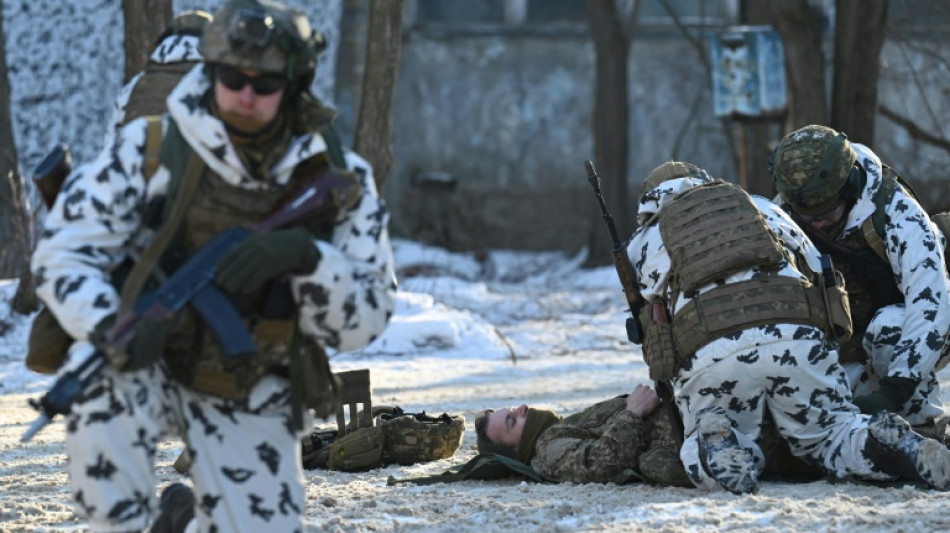
In Chernobyl ghost town, Ukraine forces train for combat

 Billionaire Trump nominee confirmed to lead NASA amid Moon race

 Melania Trump steps into spotlight in Amazon film trailer

 Safonov hero as PSG beat Flamengo in Intercontinental Cup

 Oscars to stream exclusively on YouTube from 2029: Academy

 Brazil threatens to walk if EU delays Mercosur deal

 Rob Reiner's son appears in court over parents' murder

 Three Russia-themed anti-war films shortlisted for Oscars

 Palace boss Glasner says contract talks on hold due to hectic schedule

 Venezuela says oil exports continue normally despite Trump 'blockade'

 India v South Africa 4th T20 abandoned due to fog

 EU's Mercosur trade deal hits French, Italian roadblock

 Brazil Senate debates bill that could slash Bolsonaro jail term

 Stolen Bruce Lee statue 'returns' to Bosnia town

 Warner Bros rejects Paramount bid, sticks with Netflix

 Balkan nations offer lessons on handling cow virus sowing turmoil

 UK PM warns Abramovich 'clock is ticking' over Chelsea sale fund

 Winners of 2026 World Cup to pocket $50 million in prize money

 World number one Alcaraz announces 'difficult' split with coach Ferrero

 Snicko operator admits error that led to Carey's Ashes reprieve

 Doctors in England go on strike for 14th time

 Rob Reiner's son awaiting court appearance on murder charges

 Stocks gain as traders bet on interest rate moves

 Europe's Ariane 6 rocket puts EU navigation satellites in orbit

 Hundreds queue at Louvre museum as strike vote delays opening

 Markets rise even as US jobs data fail to boost rate cut bets

Machine gun fire echoed through the abandoned buildings of Pripyat in the Chernobyl Exclusion Zone, as Ukrainian National Guard troops on Friday staged urban combat exercises.
The live-fire training -- carried out in one of the most radioactive places on earth -- came as warnings swirl over a potential Russian invasion.
Moscow has massed over 100,000 troops along Ukraine's border -- including deploying personnel to Belarus, which lies just 10 kilometres (six miles) to the north for joint drills.
For Ukraine's forces, the deserted streets and apartment blocks of Pripyat -- empty since residents were evacuated following the nuclear reactor disaster in 1986 -- made an ideal training ground.
Troops in winter camouflage practised clearing armed attackers from buildings, targeted mortar fire and took on snipers in urban conditions.
Emergency service workers staged evacuations -- a speaker on a drone telling residents to clear out -- and fought fires caused by fighting.
"As there are no civilians around here we can conduct exercises with real ammunition in a situation as close to actual urban warfare as possible," said one National Guard serviceman, giving only his call sign Litva.
But conducting exercises inside the exclusion zone has its own risks.
Ahead of the training -- the first of its kind staged in Pripyat -- workers with Geiger counters had to scan the route to check there were no radioactive hotspots.
"It has all been checked and it doesn't present a danger," Litva said confidently, as he clutched his automatic rifle to his chest.
- Radioactive hotspots -
Some Western leaders insist the threat from Russia's massed forces is real and urgent -- but authorities in Kyiv have cautioned against stirring "panic".
Ukraine's defence minister Oleksiy Reznikov played down the likelihood of an incursion by Russian forces sent to Belarus for joint drills.
While the US has said that their number could reach 30,000 -- Reznikov insisted that the "several thousand" Russians currently across the Belarusian frontier were not enough to attack.
He also pointed to difficult terrain as a major obstacle -- and the threat from radiation if they tried to push through the exclusion zone towards the capital Kyiv.
"This area is very hard to get through -- forests, swamp, rivers -- it's complicated enough to move by foot let alone with a tank," Reznikov told journalists, who had been ferried into the exclusion zone on a press tour to see the exercises.
"And don't forget that still since the disaster there remain some highly radioactive areas on the route from Belarus."
- Heightened security -
Ukraine's interior minister Denys Monastyrskiy said that due to the spike in tensions security had been stepped up around all nuclear reactors -- including the Chernobyl site, now covered by a mammoth protective sarcophagus.
"We're absolutely sure that the nuclear plant in Chernobyl is not under threat," Monastyrskiy said.
But the National Guard troops in Pripyat were not training to counter a full-scale Russian invasion.
They were instead preparing for the threat from ununiformed infiltrators who might seize buildings and stir unrest across the country.
That was what happened when Russia seized the Crimean peninsula in 2014 and began fuelling a separatist conflict in the east of Ukraine.
Ukraine's authorities insist that type of internal destabilisation remains their biggest worry.
"We have to show our readiness to react to all events," said Monastyrskiy
W.Stewart--AT