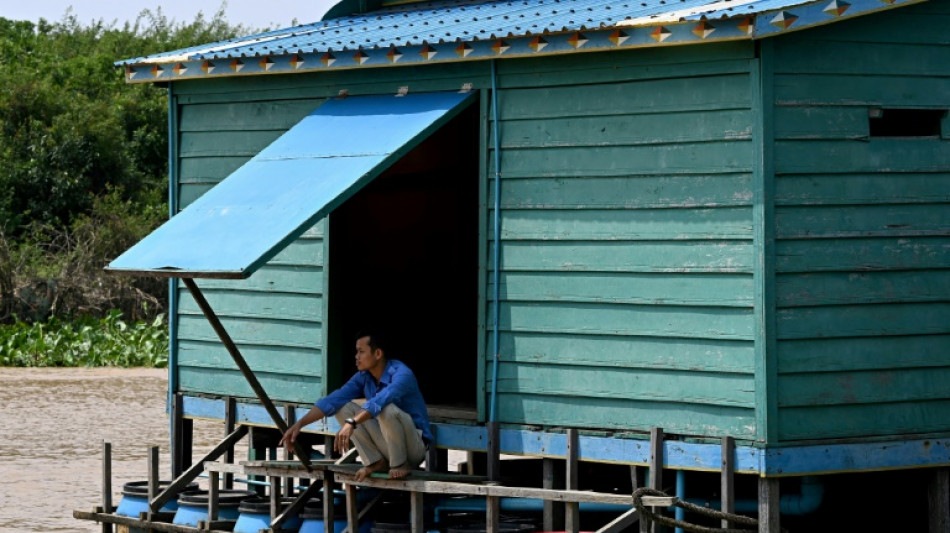
'Floating toilets' help Cambodia's lake-dwelling poor / Photo: TANG CHHIN Sothy - AFP

 'Catastrophic mismatch': Safety fears as Jake Paul faces Anthony Joshua

 Khawaja grabs lifeline as Australia reach 94-2 in 3rd Ashes Test

 Trump says orders blockade of 'sanctioned' Venezuela oil tankers

 Australia holds first funeral for Bondi Beach attack victims

 Maresca relishes support of Chelsea fans after difficult week

 Costa Rican president survives second Congress immunity vote

 Australia holds first funerals for Bondi Beach attack victims

 Rob Reiner killing: son to be charged with double murder

 Netflix boss promises Warner Bros films would still be seen in cinemas

 Stocks mostly retreat on US jobs, oil drops on Ukraine hopes

 Trump imposes full travel bans on seven more countries, Palestinians

 Shiffrin extends slalom domination with Courchevel win

 Tepid 2026 outlook dents Pfizer shares

 FIFA announces $60 World Cup tickets for 'loyal fans'

 Shiffrin dominates first run in Courchevel slalom

 Arctic sees unprecedented heat as climate impacts cascade

 Afrikaners mark pilgrimage day, resonating with their US backers

 Hamraoui loses case against PSG over lack of support after attack

 Iran refusing to allow independent medical examination of Nobel winner: family

 Australia's Green becomes most expensive overseas buy in IPL history

 Man City star Doku sidelined until new year

 EU eases 2035 combustion-engine ban to boost car industry

 US unemployment rises further, hovering at highest since 2021

 Filmmaker Rob Reiner's son to be formally charged with parents' murder

 Stocks retreat on US jobs, oil drops on Ukraine hopes

Pointing to the murky waters of the Tonle Sap, Si Vorn fights back tears as she recalls her four-year-old daughter dying from diarrhoea after playing in the polluted lake.
Her family of 12 is among 100,000 people living in floating houses on Cambodia's vast inland waterway, and while their village has 70 houses and a primary school, it has no sanitation system.
Now a local social enterprise, Wetlands Work (WW), is trying to tackle the problem by rolling out "floating toilets" to filter waste, but the high cost of installation means for now they are available to only a lucky few.
For generations, villagers whose livelihood depends on fishing have defecated directly into the water that they use for cooking, washing and bathing -- risking diarrhoea and even more severe water-borne diseases such as cholera.
"We use this water, we drink this water, and we defecate into this water. Everything!" Si Vorn, 52, told AFP, saying her family fell ill all the time.
"Every day, I worry about my health. Look at the water, there is no sanitation. I'm so worried but I don't know what to do."
- Microbe magic -
More than a million people live on or around Tonle Sap, the world's largest inland fishery, but there is no system in place for managing human waste from the 20,000 floating houses around the lake.
Cambodia, ravaged by war and the genocidal Khmer Rouge in the 1970s, is one of the poorest countries in Southeast Asia.
Around a third of the population does not have access to proper toilets, according to the WaterAid charity, and diarrhoea is a leading killer of children under five.
Wetlands Work hopes its HandyPods, as the floating toilets are properly known, can help Si Vorn's village and others like it in other countries.
HandyPods use three small tanks to filter and clean the sewage.
Human waste passes from the toilet into the first tank, then the second and third. Inside, trillions of microbes in a "biofilm" -- a slimy matrix of microorganisms -- remove pathogens and the treated water is discharged into the lake.
"We're addressing sanitation in floating villages that have never experienced sanitation before," Taber Hand, the founder of Wetlands Work, told AFP.
The resulting "grey water" may not be clean enough to drink, but it is safe to use for washing and cooking.
The company has installed 19 floating toilets in Chong Prolay, Si Vorn's village, and they have proved popular with the few that have them.
"We use this water because a bottle of clean water is 4,000 riel ($1), so we can't afford to buy clean water for using, cooking and bathing," fisherman Roeun Nov, who won a free HandyPod through a lucky draw two months ago, told AFP.
"We buy clean water for just drinking."
- Cost a barrier -
WW has installed more than 100 HandyPods in 20 villages on the lake through two separate projects funded by European Union, and aims to roll out 200 more by 2025.
The hope is that the more villagers see the toilets in action, the more they will want proper sanitation.
Outside Cambodia, WW has also installed the system in 12 villages in Myanmar, but cost is a major obstacle to widespread adoption.
The floating toilets cost around $175 each -- a huge sum of money for Tonle Sap fishing communities, where on a good day a villager might make $5.
Hand said his team was considering subsidies in the longer term, so that families would only pay $35 to $40 for a treatment system.
Chan Sopheary, a WW field officer, said lake people were beginning to change their behaviour around sanitation and hygiene, but they were not willing to pay for the toilet yet given their poor livelihoods.
"We cannot afford one because we just make enough money for daily spending," Si Vorn's husband Yoeun Sal told AFP after bathing in water by his house during a hot afternoon.
"If no one helps us, we will keep using the lake (as a toilet)," he added.
N.Mitchell--AT
