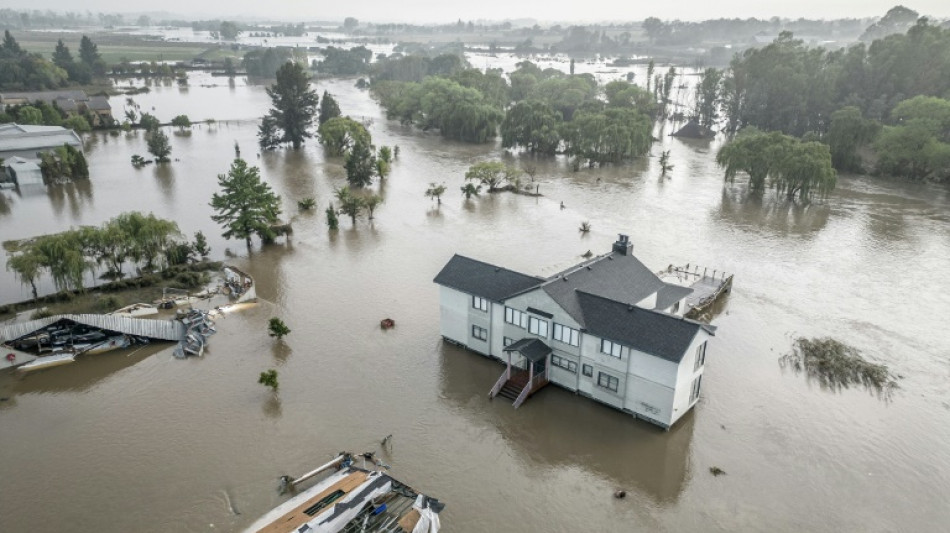
UN's global disaster alert systems goal faces uphill climb / Photo: Shiraaz Mohamed - AFP/File

 Myanmar junta seeks to prosecute hundreds for election 'disruption'

 Knicks beat Spurs in NBA Cup final to end 52-year trophy drought

 Grief and fear as Sydney's Jewish community mourns 'Bondi rabbi'

 Brazil Senate to debate bill to slash Bolsonaro jail term

 Eurovision facing fractious 2026 as unity unravels

 Asian markets drift as US jobs data fails to boost rate cut hopes

 Ukraine's lost generation caught in 'eternal lockdown'

 Australia's Steve Smith ruled out of third Ashes Test

 Undefeated boxing great Crawford announces retirement

 UK experiences sunniest year on record

 FIFA announces $60 World Cup tickets after pricing backlash

 Nested Knowledge and Pharmacy Podcast Network Announce Strategic Collaboration to Advance Evidence-Based Podcasting in Healthcare

 Costa Rican president survives second Congress immunity vote

 Australia holds first funerals for Bondi Beach attack victims

 Rob Reiner killing: son to be charged with double murder

 Netflix boss promises Warner Bros films would still be seen in cinemas

 Stocks mostly retreat on US jobs, oil drops on Ukraine hopes

 Trump imposes full travel bans on seven more countries, Palestinians

 Shiffrin extends slalom domination with Courchevel win

 Tepid 2026 outlook dents Pfizer shares

 FIFA announces $60 World Cup tickets for 'loyal fans'

 Shiffrin dominates first run in Courchevel slalom

 Arctic sees unprecedented heat as climate impacts cascade

 Afrikaners mark pilgrimage day, resonating with their US backers

 Hamraoui loses case against PSG over lack of support after attack

How can anyone seek shelter from a natural disaster they don't even know is coming? Last year the United Nations called for every person on the planet to be covered by early warning systems by 2027 -- but months into the effort it is becoming clear that the project will require more data and expertise.
With a relatively low price tag of $3.1 billion, the UN's plan hopes to implement the simple principle of early warning systems: assess risks using meteorological data, forecast impending problems using modelling, prepare populations ahead of time, and send out alerts to those expected to be impacted.
But building out those steps poses unique issues at each turn, according to those involved in the effort, many of whom are gathered this week in New York for a historic UN conference on water-related crises.
In Tajikistan, 100 years of weather data exist only on paper, chair of the country's environmental protection committee, Bahodur Sheralizoda said.
Digitizing this data could provide "more precise weather forecasts" or be applied to climate modeling, he added.
"With the small investments, we can have really big impact in the long run."
To help fill the data gap, the US National Oceanic and Atmospheric Administration (NOAA) is also hoping to deploy weather stations made from 3D printers around the world, said the agency's chief scientist Sarah Kapnick.
When it comes to analyzing the meteorological data and predicting future weather events, there is also a lack of local expertise, said Stefan Uhlenbrook, director of hydrology, water and cryosphere at the UN World Meteorological Organization (WMO).
"You need local capacity to run the local models," he told AFP.
Some help should be coming from NOAA, which Kapnick said has plans to "train local climate forecasters and leaders."
After risks are identified, getting those alerts to remote populations poses possibly the biggest hurdle.
"To reach the last mile... and then to get them acting and prepared is a big challenge," said Uhlenbrook.
This is where the International Federation of Red Cross and Red Crescent Societies (IFRC), a WMO partner in the field, comes in.
- Regular training and drills -
For IFRC Secretary General Jagan Chapagain, the country of Bangladesh should be viewed as a model to replicate.
Scarred by the horrific 1970 cyclone that killed hundreds of thousands, the South Asian country has for decades built up storm-resistant shelters and warns residents of upcoming dangers, by bicycle if necessary, Chapagain told AFP.
While church bells, loudspeakers and sirens are still used as warning systems in many isolated places, alerts sent via radio, TV and SMS have become the norm.
"In 2022, 95 percent of the world's population had access to mobile broadband networks and close to 75 percent of the population owned a mobile phone," said Ursula Wynhoven with the International Telecommunications Union (ITU).
That makes mobile networks "powerful communication channels" for alerts, especially because "SMS warnings can be targeted to reach only those located in an at-risk area," she added.
Few developing countries have installed such systems, she said, noting a "relatively low cost."
WMO chief Petteri Taalas also highlighted the cost effectiveness of setting up early warning programs, saying that "you'll get the money back at least tenfold that you invest."
He pledged at the UN Water conference to speed up implementation of the UN's 2027 goal, beginning with water-related disasters.
Floods and droughts account for 75 percent of climate-related disasters, which are expected to increase further due to global warming.
But simply alerting a population is not enough -- there must also be "regular training and drills," warns IFRC chief Chapagain.
People must practice the processes of interpreting different signals and finding the nearest escape routes or shelter.
"Once people understand the logic, they manage these things better," he said.
While climate change is expected to intensify storms, at the opposite extreme, it is also expected to increase the severity of droughts.
Though the potential for drought-induced disaster happens more slowly, Uhlenbrook said, warnings are still important to protect livelihoods.
For example, "we had in Europe a very dry, warm winter, so the (water) reservoir levels are very low," Uhlenbrook said.
Farmers near Italy's Po River who plan to plant rice, which need lots of irrigation, should take that into consideration, he explained.
NOAA's Kapnick highlighted that drought predictions, based off advanced climate modeling, are of particular importance in "developing nations with heavily agriculturally based economies."
"Early warning systems based on seasonal predictions are critical for planning for food security and macro-economic forecasts," she said.
M.O.Allen--AT
