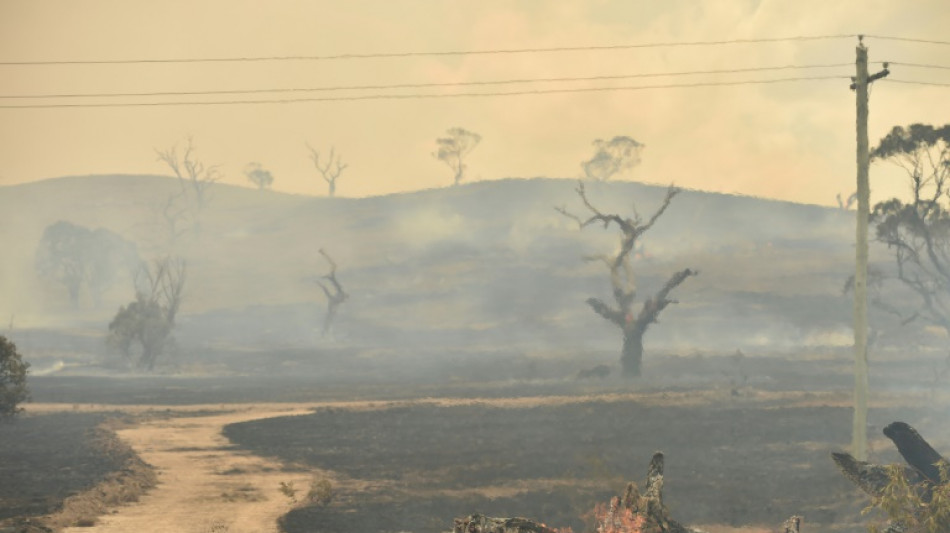
Australian bushfires may have helped trigger La Nina / Photo: PETER PARKS - AFP

 Myanmar junta seeks to prosecute hundreds for election 'disruption'

 Knicks beat Spurs in NBA Cup final to end 52-year trophy drought

 Grief and fear as Sydney's Jewish community mourns 'Bondi rabbi'

 Brazil Senate to debate bill to slash Bolsonaro jail term

 Eurovision facing fractious 2026 as unity unravels

 Asian markets drift as US jobs data fails to boost rate cut hopes

 Ukraine's lost generation caught in 'eternal lockdown'

 Australia's Steve Smith ruled out of third Ashes Test

 Undefeated boxing great Crawford announces retirement

 UK experiences sunniest year on record

 FIFA announces $60 World Cup tickets after pricing backlash

 Nested Knowledge and Pharmacy Podcast Network Announce Strategic Collaboration to Advance Evidence-Based Podcasting in Healthcare

 Costa Rican president survives second Congress immunity vote

 Australia holds first funerals for Bondi Beach attack victims

 Rob Reiner killing: son to be charged with double murder

 Netflix boss promises Warner Bros films would still be seen in cinemas

 Stocks mostly retreat on US jobs, oil drops on Ukraine hopes

 Trump imposes full travel bans on seven more countries, Palestinians

 Shiffrin extends slalom domination with Courchevel win

 Tepid 2026 outlook dents Pfizer shares

 FIFA announces $60 World Cup tickets for 'loyal fans'

 Shiffrin dominates first run in Courchevel slalom

 Arctic sees unprecedented heat as climate impacts cascade

 Afrikaners mark pilgrimage day, resonating with their US backers

 Hamraoui loses case against PSG over lack of support after attack

Australia's "Black Summer" bushfire catastrophe coughed up so much smoke it may have fuelled the global onset of La Nina in 2020, according to new research published Thursday.
The report, in peer-reviewed journal Science Advances, said the bushfires were "exceptional" in their severity -- pumping out emissions on a scale similar to major volcanic eruptions.
It suggested this led to the formation of vast banks of cloud over the southeastern Pacific Ocean, which soaked up radiation from the sun and led to the cooling of surface water temperatures.
These disruptions could have helped trigger the start of an unusually long La Nina weather pattern, the researchers found.
The "Black Summer" bushfires raged across Australia's eastern seaboard from late 2019 to early 2020, razing swathes of forest, killing millions of animals, and blanketing cities in noxious smoke.
A rare "triple-dip" La Nina shaped global weather patterns between September 2020 and March 2023, whipping up a series of devastating tropical cyclones while exacerbating droughts in other parts of the planet.
Researchers John Fasullo and Nan Rosenbloom, from the National Center for Atmospheric Research in the United States, used modelling to demonstrate how emissions from the bushfires could shift weather patterns.
Bushfire smoke is laden with particles that act as "condensation nuclei", which attract water molecules in the atmosphere, seeding the formation of clouds.
- Atmospheric impact -
This blanket of cloud could cause "widespread surface cooling" in the tropical Pacific Ocean, the modelling showed, which is one of the key ingredients for the start of La Nina.
"The results here suggest a potential connection between this emergence of cool conditions in the eastern Pacific Ocean and the climate response to the Australian wildfire emissions," the paper stated.
Australian climate scientist Tom Mortlock said the bushfires caused clouds to form in a part of the Pacific that plays a crucial role in global climate regulation.
"The southeast corner of the Pacific is a really sensitive and important area for what goes on with El Nino and La Nina," he told AFP.
"Often we see the first signs of an El Nino or La Nina forming in that part of the ocean."
Pete Strutton, from the Australian Centre of Excellence for Climate Extremes, said it demonstrated the sheer scale of the bushfires.
"We've got an event that happened on the land in southeast Australia, which is having an impact on the atmosphere," he told AFP.
A separate team of British researchers last year found that the "Black Summer" bushfires spewed millions of tonnes of emissions into the atmosphere, likely aggravating the Antarctic ozone hole.
Global weather patterns oscillate between cooling La Nina and warming El Nino cycles -- with neutral conditions in between.
R.Garcia--AT
