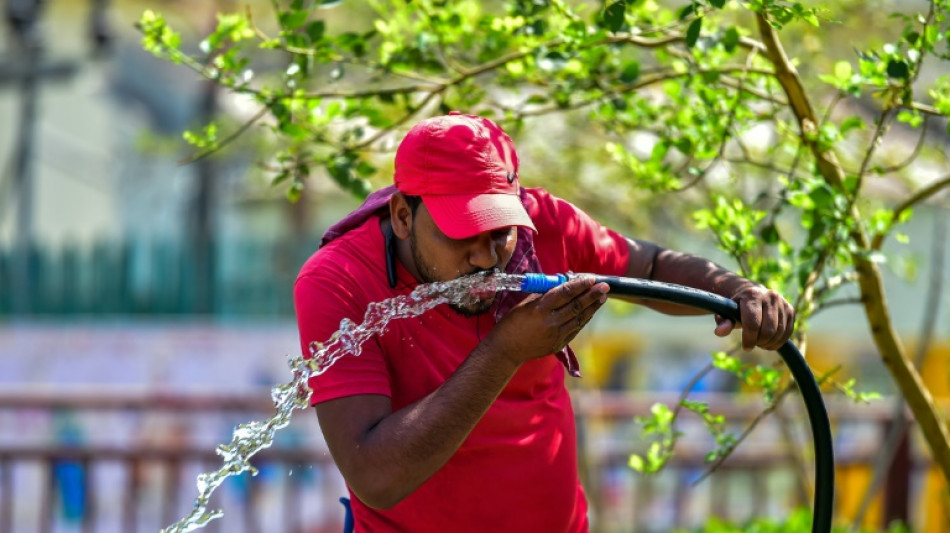
Asia heatwaves made 30 times more likely by climate change: study / Photo: SANJAY KANOJIA - AFP/File

 Cherki inspires Man City, Newcastle strike late to reach League Cup semis

 Venezuela reacts defiantly to US oil blockade, claims exports unaffected

 S.Africa expels Kenyans working on US Afrikaner 'refugee' applications

 Cherki inspires Man City cruise into League Cup semis

 Mahomes undergoes surgery, could return for 2026 opener: Chiefs

 Brazil Senate advances bill that could cut Bolsonaro jail term

 Oscars to stream exclusively on YouTube from 2029

 CNN's future unclear as Trump applies pressure

 Zelensky says Russia preparing for new 'year of war'

 US Congress passes defense bill defying Trump anti-Europe rhetoric

 US oil blockade of Venezuela: what we know

 Netflix to launch FIFA World Cup video game

 German MPs approve 50 bn euros in military purchases

 Hydrogen plays part in global warming: study

 What next for Belarus after US deal on prisoners, sanctions?

 Coe shares 'frustration' over marathon record despite Kenyan's doping ban

 Veteran Suarez signs new Inter Miami contract

 Crude prices surge after Trump orders Venezuela oil blockade

 French readers lap up Sarkozy's prison diaries

 Warner Bros. Discovery rejects Paramount bid

 World no. 1 Alcaraz ends 'incredible ride' with coach Ferrero

 Iran boxer sentenced to death at 'imminent' risk of execution: rights groups

 Finland PM apologises to Asian countries over MPs' mocking posts

 Romania journalists back media outlet that sparked graft protests

 Ghana's Highlife finds its rhythm on UNESCO world stage

Climate change made record-breaking deadly heatwaves in Bangladesh, India, Laos and Thailand last month at least 30 times more likely, according to a study published Wednesday.
Parts of India saw temperatures above 44 degrees Celsius (111 Fahrenheit) in mid-April, with at least 11 deaths near Mumbai attributed to heat stroke on a single day. In Bangladesh, Dhaka suffered its hottest day in almost 60 years.
The city of Tak in Thailand saw its highest-ever temperature of 45.4 Celsius, while Sainyabuli province in Laos hit 42.9 Celsius, an all-time national temperature record, the study by the World Weather Attribution group said.
Two deaths were reported in Thailand, but the real toll was likely higher as the extreme heat caused widespread hospitalisations, with the poor and vulnerable the worst affected.
The new study by international climate scientists looked at the average maximum temperature and the maximum heat index, which includes humidity.
"In both regions, the researchers found that climate change made the humid heatwave at least 30 times more likely, with temperatures at least 2 degrees Celsius hotter than they would have been without climate change," WWA said in a statement.
"Until overall greenhouse gas emissions are halted, global temperatures will continue to increase and events like this will become more frequent and severe," it added.
The analysis also found that such events in India and Bangladesh, previously once-a-century, can now be expected around once every five years because of human-caused climate change.
For Laos and Thailand, if global temperatures rise by two degrees Celsius -- as will happen within around 30 years if emissions are not cut rapidly -- such extreme events could happen every 20 years, compared to every two centuries now, the study said.
"We see again and again that climate change dramatically increases the frequency and intensity of heatwaves, one of the deadliest weather events there are," said Friederike Otto of the Grantham Institute for Climate Change and the Environment, who was involved in the study.
"Still, heat action plans are only being introduced very slowly across the globe. They need to be an absolute priority adaptation action everywhere, but in particular in places where high humidity enhances the impacts of heatwaves," she added.
Scientists were previously reluctant to directly link a particular event to climate change, but in recent years a new field of "attribution science", like that done by the WWA, has emerged.
Some weather events have a more complicated relationship to global warming than others, with the relationship to heatwaves and increased rainfall relatively easy to study.
Other phenomena such as droughts, snowstorms, tropical storms and wildfires are more complicated however, according to the WWA.
F.Wilson--AT


