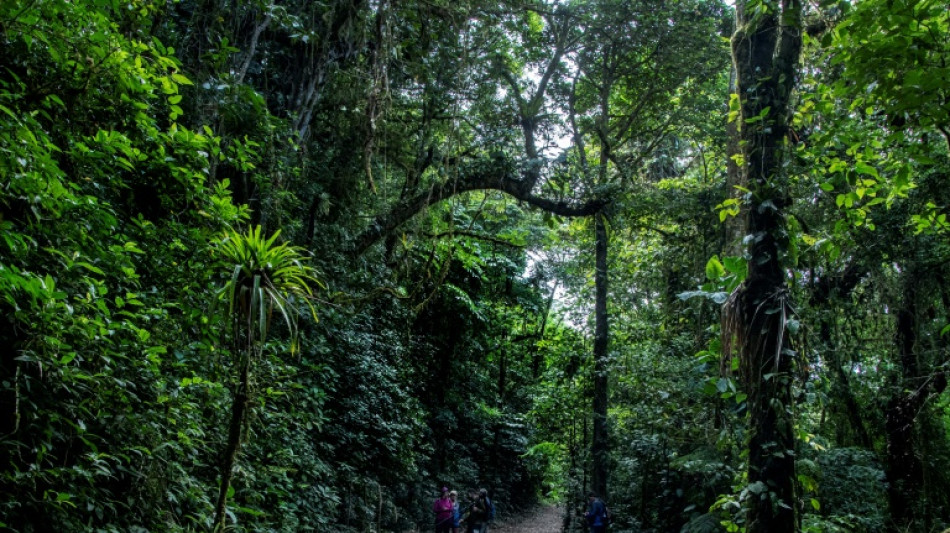
In Costa Rica, climate change threatens 'cloud forest' / Photo: Ezequiel BECERRA - AFP

 Cherki inspires Man City, Newcastle strike late to reach League Cup semis

 Venezuela reacts defiantly to US oil blockade, claims exports unaffected

 S.Africa expels Kenyans working on US Afrikaner 'refugee' applications

 Cherki inspires Man City cruise into League Cup semis

 Mahomes undergoes surgery, could return for 2026 opener: Chiefs

 Brazil Senate advances bill that could cut Bolsonaro jail term

 Oscars to stream exclusively on YouTube from 2029

 CNN's future unclear as Trump applies pressure

 Zelensky says Russia preparing for new 'year of war'

 US Congress passes defense bill defying Trump anti-Europe rhetoric

 US oil blockade of Venezuela: what we know

 Netflix to launch FIFA World Cup video game

 German MPs approve 50 bn euros in military purchases

 Hydrogen plays part in global warming: study

 What next for Belarus after US deal on prisoners, sanctions?

 Coe shares 'frustration' over marathon record despite Kenyan's doping ban

 Veteran Suarez signs new Inter Miami contract

 Crude prices surge after Trump orders Venezuela oil blockade

 French readers lap up Sarkozy's prison diaries

 Warner Bros. Discovery rejects Paramount bid

 World no. 1 Alcaraz ends 'incredible ride' with coach Ferrero

 Iran boxer sentenced to death at 'imminent' risk of execution: rights groups

 Finland PM apologises to Asian countries over MPs' mocking posts

 Romania journalists back media outlet that sparked graft protests

 Ghana's Highlife finds its rhythm on UNESCO world stage

The "cloud forest" of Monteverde, in the center of Costa Rica, will soon no longer be worthy of the name: climate change threatens this unique ecosystem, and its fauna and flora face an unclear future under a brilliant blue sky.
In the forest, what a visitor should hear is the constant drip of moisture falling from the trees. Instead, it is the sound of dead branches snapping underfoot that breaks the silence on the dry trails.
The high-altitude forest is still clinging to life, and it delights walkers with an infinite variety of greens under an uncomfortably bright sun: the fog which reigned supreme here only a short time ago dissipates as the temperature rises, explained 24-year-old forest guide Andrey Castrillo.
"The forest should be cool," he said. "You should hear the drops falling all over the forest, but that only happens during the wettest and windiest days of the rainy season."
"Here there was no sun... We had about 30 days of sunshine a year. Now we have more than 130," he said.
At 1,400 meters (4,600 feet) above sea level and 140 kilometers (86 miles) northwest of the capital San Jose, the private nature reserve extends over 14,200 hectares (35,000 acres) and is home to a hundred species of mammals, 440 bird species and 1,200 types of amphibians.
- 'Walking in the clouds' -
This exceptional type of altitude forest represents only one percent of the world's tropical and subtropical areas.
"Near-ground cloud cover forms when the humidity saturation is above 90 percent with temperatures between 14 and 18 degrees Celsius (57 to 64 degrees Fahrenheit)," researcher Ana Maria Duran, of the University of Costa Rica, told AFP.
The researcher said she had been coming here regularly for more than twenty years.
Normally, the "almost permanent" fog gives the impression of "practically walking in the middle of the clouds," with visibility down to barely a meter (three feet).
As she spoke, she stared into the forest where the temperature had risen to more than 25 degrees Celsius, under a blue sky where only a few clouds crowned the peaks.
"Coming to Monteverde to find such dry conditions and not being in the clouds like it was 20 years ago when I started coming is obviously very sad," said Duran.
Rising temperatures mean lower humidity and more sun. The mosses have dried on the tree trunks, the rivers are no more than streams, and the amphibians here have been the first victims of climate change.
"The decline of amphibians in cloud forests may serve as a wake-up call," warned biologist Andrea Vincent, who teaches at the University of Costa Rica.
Already, the species Incilius periglenes, known as the golden frog, has been considered extinct since 2019 by the International Union for Conservation of Nature (IUCN).
"A cloudless cloud forest, it will disappear, it has to," said Vincent, warning that "there will be a lot of extinctions" of various species.
But this "dispiriting scenario" can still be avoided, she said.
"Ecosystems are resilient. If we make efforts to stop climate change it is possible that cloud forests will recover... not during our lifetime but perhaps for the next generations".
M.Robinson--AT


