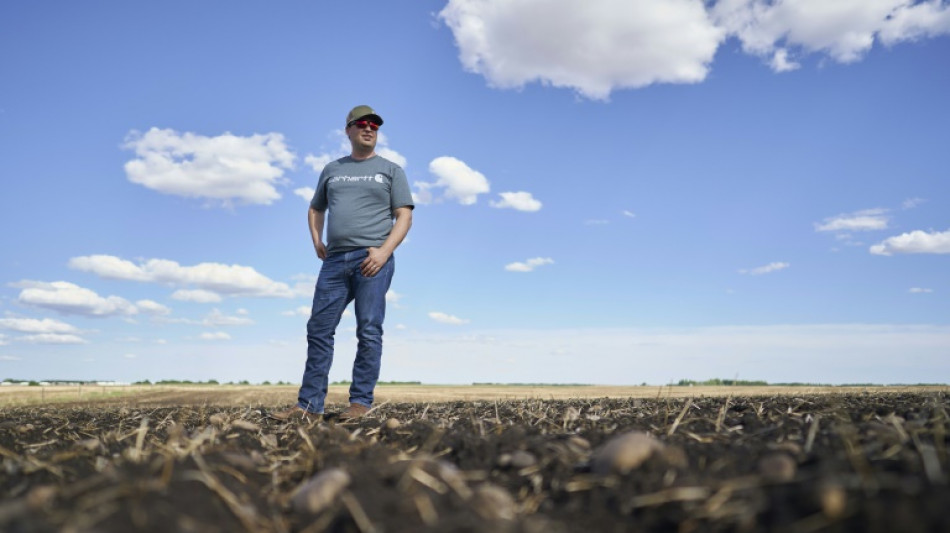
Canadian Prairies farmers try to adapt to a warming world / Photo: Geoff Robins - AFP

 Myanmar junta seeks to prosecute hundreds for election 'disruption'

 Knicks beat Spurs in NBA Cup final to end 52-year trophy drought

 Grief and fear as Sydney's Jewish community mourns 'Bondi rabbi'

 Brazil Senate to debate bill to slash Bolsonaro jail term

 Eurovision facing fractious 2026 as unity unravels

 Asian markets drift as US jobs data fails to boost rate cut hopes

 Ukraine's lost generation caught in 'eternal lockdown'

 Australia's Steve Smith ruled out of third Ashes Test

 Undefeated boxing great Crawford announces retirement

 UK experiences sunniest year on record

 FIFA announces $60 World Cup tickets after pricing backlash

 Nested Knowledge and Pharmacy Podcast Network Announce Strategic Collaboration to Advance Evidence-Based Podcasting in Healthcare

 Costa Rican president survives second Congress immunity vote

 Australia holds first funerals for Bondi Beach attack victims

 Rob Reiner killing: son to be charged with double murder

 Netflix boss promises Warner Bros films would still be seen in cinemas

 Stocks mostly retreat on US jobs, oil drops on Ukraine hopes

 Trump imposes full travel bans on seven more countries, Palestinians

 Shiffrin extends slalom domination with Courchevel win

 Tepid 2026 outlook dents Pfizer shares

 FIFA announces $60 World Cup tickets for 'loyal fans'

 Shiffrin dominates first run in Courchevel slalom

 Arctic sees unprecedented heat as climate impacts cascade

 Afrikaners mark pilgrimage day, resonating with their US backers

 Hamraoui loses case against PSG over lack of support after attack

Following repeated droughts, Canadian farmers are trying to adapt to a new era in agriculture marked by a warming world -- including by trapping snow in their fields, planting heat-resistant crops and seeding earlier in the season.
But it's unclear, they are the first to admit, if their slogging will bear fruit.
Squatting in the middle of a canola field in Alberta, on the western edge of Canada's vast Prairies region, Ian Chitwood surveys the shoots sprouting between long furrows of black soil.
His battle with the heat has been starting earlier every year.
By planting his crops earlier in the season, in May, Chitwood aims to "move up the flowering window," during which the plants are most vulnerable, in order to protect them from the heat in June.
But what his crops really need in the wake of a devastating drought in 2021, he acknowledges, is mild weather and humid soil.
That drought was a "once in 100 years event," says Curtis Rempel of the Canola Council of Canada.
That year, the west of the country sweltered under record high summer temperatures, with the mercury reaching 49.6 degrees Celsius (121.3 Fahrenheit).
"It sure had an impact on yields," reducing them by 50 percent, according to Rempel.
Such hits have had significant impacts on international markets, as Canada exports 90 percent of its canola harvest -- used mostly for cooking oil and biodiesel fuel.
- Water management -
Most canola crops are grown without requiring irrigation in the Prairies, the nation's agricultural heartland spanning nearly 1.8 million square kilometers (695,000 square miles). But the region is sensitive to droughts, whose frequency and severity have been steadily increasing.
In this region, explains Phillip Harder, a hydrology researcher at the University of Saskatchewan, in Saskatoon, "crop production relies on water that accumulates throughout the year." In other words, snow that accumulates over winter and soaks into the ground during the spring thaw.
But howling winds over fields that stretch as far as the eye can see have been blowing away much of that snow of late.
Some farmers have turned to a century-old solution of planting trees in and around their fields to trap the snow.
"In the wintertime when the snow blows it catches in the trees, and then it slowly soaks into the ground," explains Stuart Dougan, a 69-year-old farmer with a weather-beaten face.
In the spring and summer, the trees provide further shelter from the wind "so it's not taking the moisture from the crops," he adds.
Trees may pose new challenges, however, as modern agricultural equipment is much bulkier than in the 1930s when one could more easily plow around a tree trunk, points out Harder.
Alternatively, he recommends when harvesting crops to cut the plants higher on the stem, leaving longer "stubble" sticking out of the ground to "increase snow retention."
- Turning to science -
"We've always looked to keep as much stubble in place to catch the snow and reduce evaporation rates," says Saskatchewan farmer Rob Stone. He, like many Canadian farmers, stopped plowing his fields in the 1990s for this very purpose.
He's now experimenting with new genetically modified seeds that he says hold hope for the future of canola. Four small flags in the middle of his fields mark a test crop.
"As we find ones that are more tolerant (to heat), we will crossbreed them to make a new (plant) population," explains Greg Gingera, a genetics researcher.
Also in the works, adds Rempel, are several companies looking to develop "biologicals or bacteria or fungi that you add to the soil or spray on top of the plant to confer stress tolerance."
But it will be seven to eight years before a product is likely ready to be commercialized and widely available, he says.
In the meantime, farmers will have to make do.
Y.Baker--AT
